Unlocking the Mystery: The Thrill of Case Opening Revealed
Few phenomena in modern gaming have captured the intersection of video games, economics, and pure adrenaline quite like the CS:GO case opening system. Even though Counter-Strike: Global Offensive has officially transitioned into Counter-Strike 2 (CS2), the tradition of acquiring, buying, and unlocking weapon cases remains a massive part of the community’s culture.
For the uninitiated, watching the digital reel spin past dozens of weapons—hoping it slows down on a rare, glowing knife—is a thrilling experience. However, beneath the flashing lights and community hype lies a complex system of probability, real-world economics, and digital asset management. This guide explores everything players need to know about CS:GO and CS2 case openings.
How Case Opening Works in Counter-Strike
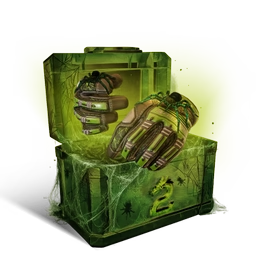
To open a case in Counter-Strike, a player needs two things: a Weapon Case and a Key.
- Acquiring Cases: Cases drop randomly during weekly gameplay, can be purchased on the Steam Community Market, or traded with other players.
- Acquiring Keys: Keys can be purchased directly in-game for a standardized price (usually around £2.50 GBP) or traded through the Steam community, though Valve implemented trade-lock restrictions to combat gambling and fraud.
- The Roll: Once a key is used on a corresponding case, an animation begins. The player watches as various weapon finishes scroll horizontally across the screen, eventually coming to a stop on a single item. That item is then added directly to the player’s inventory.
Understanding the Odds: What Are the Real Chances?
Transparency regarding drop rates has always been a subject of intense debate within the gaming community. Thanks to regulations in countries like China, Valve was legally required to publish the official drop rates for cases.
The mathematics behind a case opening are heavily skewed in favor of the house. Here is a breakdown of the statistical probabilities of pulling items of various rarities:
| Weapon Tier (Rarity) | Item Color | Approximate Drop Rate |
|---|---|---|
| Consumer Grade / Base | White | 0.00% (Not found in standard cases) |
| Mil-Spec Grade | Blue | ~79.92% |
| Restricted | Purple | ~15.98% |
| Classified | Pink | ~3.20% |
| Covert | Red | ~0.64% |
| Special Rare (Knives/Gloves) | Gold | ~0.26% |
As the table clearly demonstrates, players have roughly a 1 in 400 chance of unboxing a knife or pair of gloves.
The Economics of the Steam Market
The CS:GO economy is entirely player-driven, managed through the Steam Community Market and third-party trading sites. Because keys have a fixed price and case supplies fluctuate based on active drop pools, the value of unboxed items varies wildly.
Factors That Influence Skin Value:
- Float Value (Wear): Items range from Factory New (FN) to Battle-Scarred (BS). Generally, the cleaner the look, the higher the price, though some “Battle-Scarred” floats are so rare they command collector prices.
- StatTrak™ Technology: Items with the StatTrak™ prefix track the number of kills made with that specific weapon. These are rarer variations of standard drops.
- Pattern Templates: Certain skins (like the Case Hardened series) feature algorithms that generate unique color distributions based on a pattern index. A “Blue Gem” pattern can multiply a knife’s value exponentially.
- Supply and Demand: When Valve moves a case into the “Rare Drop Pool,” the supply of that specific case dwindles, driving up both the price of the case and the potential value of its contents.
The Allure and Risks: Why Do Players Keep Opening Cases?
Psychologists and gaming analysts often compare CS:GO case openings to slot machines. The mechanics rely heavily on variable-ratio reinforcement schedules—the exact same psychological trigger that makes traditional gambling addictive.
Common Reasons Players Open Cases:
- The Thrill of the Chase: The anticipation built during the final seconds of the spin releases a rush of dopamine.
- Investment Potential: Stories of players turning a £2.50 key into a £1,500 Butterfly Knife inspire others to try their luck.
- Personalization: Players want unique weapon skins to express their personality or match their team’s aesthetic during competitive matches.
A Word of Caution: Statistically, the vast majority of players lose money through case openings. The average return on investment (ROI) per case is significantly lower than the cost of the key. Treat case openings strictly as entertainment, akin to buying a lottery ticket, rather than an investment strategy.
Best Practices for Managing Your Inventory
If you plan to participate in case openings or skin trading, following a few ground rules can save you from financial regret:
- Set a Strict Budget: Decide how much money you are willing to spend each month (e.g., £10 or £20) and never exceed that limit, regardless of your results.
- Buy Singles Instead of Opening: If you have your heart set on a specific skin (like an AK-47 Redline or an M4A4 Desolate Space), you will almost always save money by buying it outright from the Steam Market rather than gambling on cases.
- Keep Your Account Secure: High-value inventories make players targets for phishing scams and API hijacking. Never log into third-party gambling or trading sites using your primary Steam credentials unless you can independently verify their legitimacy.
- Understand Trade Holds: Remember that newly purchased or traded items come with a 7-day trade cooldown, preventing instant reselling or trading.
Frequently Asked Questions (FAQ)
1. Does Counter-Strike 2 (CS2) use the same cases as CS:GO?
Yes. All weapon cases, skins, stickers, and knives carried over seamlessly from CS:GO into the updated CS2 engine. Furthermore, visual upgrades in CS2 made many classic skins look even more vibrant.
2. Can I get banned for using third-party case opening websites?
While opening cases on third-party websites isn’t inherently banned by Valve, many of these sites operate in a legal gray area and have been associated with scams or bot activity. Valve regularly cracks down on gambling and trading bots, so use third-party platforms at your own risk.
3. What is the most expensive item you can unbox?
Factory New Souvenir packages or rare knives—such as the Karambit | Case Hardened (Blue Gem) or high-tier Sport Gloves—can fetch tens of thousands of dollars on the open market, though the chances of pulling one are microscopic.
4. Are drop rates influenced by how many cases I open?
No. Every single case opening is an independent statistical event. Opening 100 cases does not increase your odds of pulling a knife on the 101st case; the odds reset completely every time.
CS:GO and CS2 case openings remain a fascinating cultural cornerstone of the tactical shooter. Whether you prefer to spectate your favorite streamers lose hundreds of dollars chasing a red skin, or you occasionally buy a key to celebrate a hard-fought match win, the system offers an undeniably exciting dimension to the game. Just remember to play responsibly, enjoy the game for what it is, and never spend more than you can comfortably afford to lose!
Stay ahead of the Case Skin market with CS2Skin—browse skin details, case highlights, and useful insights for collectors.